Mythos Sentinel

Anti-spyware & forensics for Android

Detect the signs of spyware, stalkerware and interception on your Android

On-device forensic analysis, no root. Mythos Sentinel looks for indicators compatible with spyware, stalkerware, IMSI-catchers and state-grade spyware (Pegasus/Predator, Amnesty/MVT set) and correlates them into an honest verdict — with a PC Command Center for deep analysis.

47analysis modules
On-deviceanalysis on the phone, diagnostics only with your consent
AIrisk summary in plain words
App + cable certainty comes from connecting the phone to a computer

Download

Get Mythos Sentinel for Android.

Forensic anti-spyware analysis straight from the Google Play Store. 7 days fully unlocked, no card needed: after that, manual scans stay free — only continuous monitoring becomes a subscription. No root required.

Android Get it on Google Play

Install the app, run the first forensic scan and get a clear verdict on the surveillance signals of your device.

Get it on Google Play
Windows · Command Center Not a download: I run it for you

The Command Center analyses the phone connected by cable and reaches where the app alone cannot. We do not sell it as a program to install: it is the tool used during the consultation, on your phone, with you.

How the consultation works

Android App

A simple dashboard for complex signals.

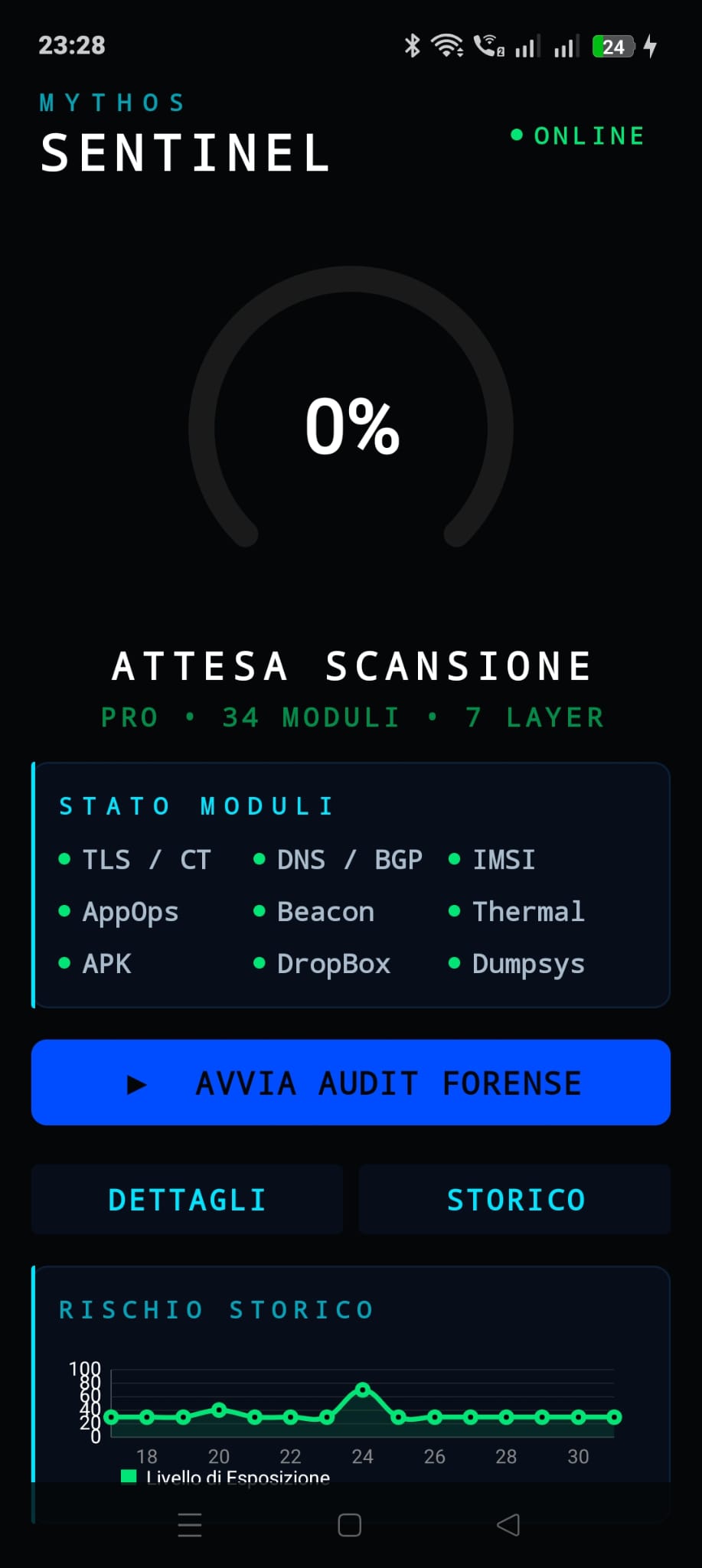
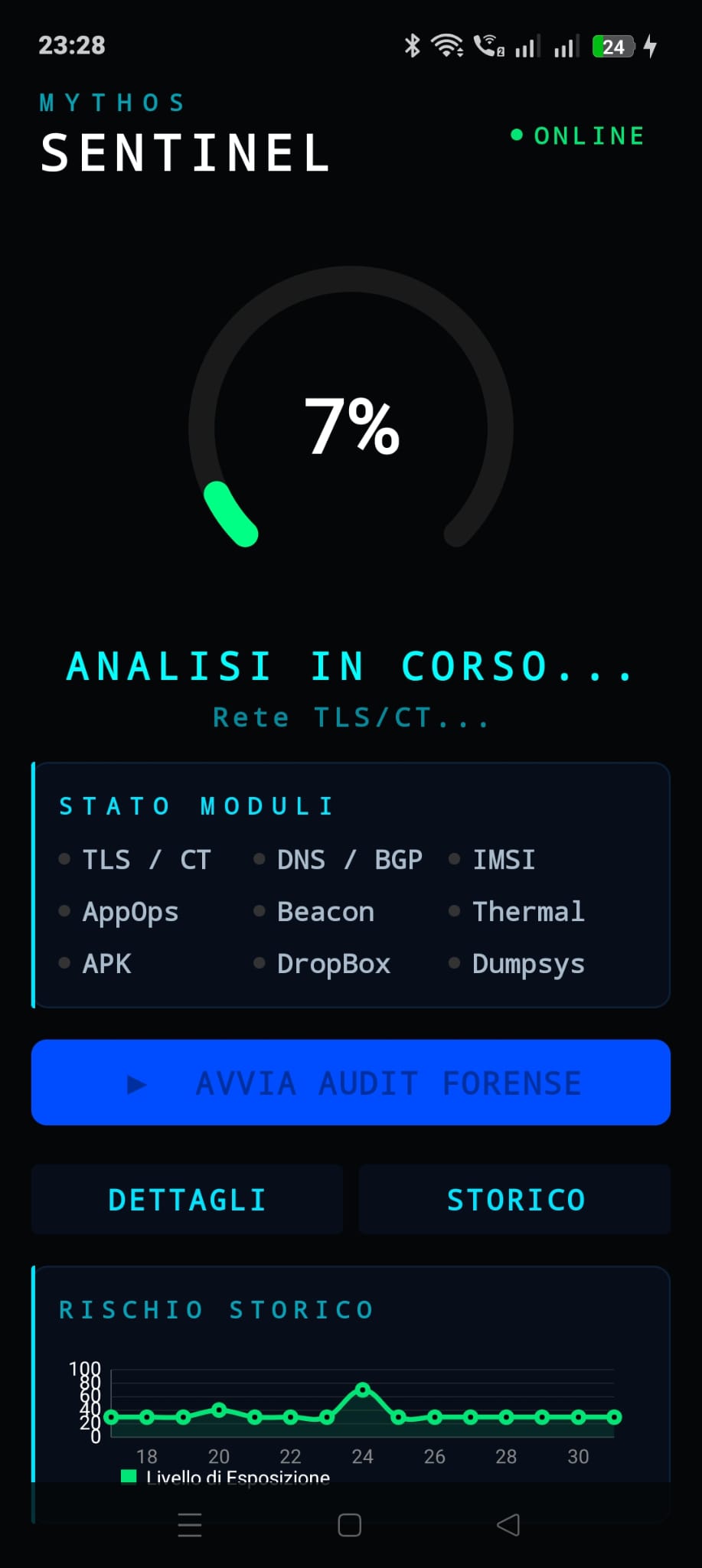
Sentinel gathers indicators from network, installed apps, sensor use, radio cells, system integrity, clipboard, processes and historical memory. The strength is not a single alert: it's the correlation between different signals.

  • Manual forensic audit with exportable report.
  • Hunt Mode to follow recurring anomalies even when they disappear.
  • Scenario analysis for advanced spyware, MITM, stalkerware and rootkits.
Mythos Sentinel dashboard awaiting scan Mythos Sentinel scan in progress

What it looks at, in plain words

Forty-seven checks, and not one of them trusts the others.

Who your phone is talking to

If someone is listening to you, sooner or later they have to send it somewhere. Mythos looks at where the traffic goes, whether anyone has placed themselves between you and the sites you open, and whether a contacted address appears in the public lists of servers used by spyware.

What apps do when you are not looking

Which apps can read your screen, switch on the microphone, or see what you copy. Which ones wake up at night, which have no icon to open them, which have changed without anyone updating them.

When the phone says things that do not add up

A phone that reports sleeping while transmitting twenty megabytes is telling a lie — and the lie shows even when the one who told it is well hidden. Mythos compares the things that must agree with each other.

What is around you

The cell towers your phone attaches to, the Bluetooth devices that follow you from room to room, the cameras on your home Wi-Fi. Not all surveillance lives inside the phone.

The ideas you will not find elsewhere

Someone who hides well is not found by looking for them. They are found by being put in contradiction.

Modern spyware is written by people better at hiding than we are at seeking. Looking for it by name is a race lost before it starts: names change every week. So Mythos does something else — it looks for the traces that hiding forces anyone to leave, because to do their job they have to move something.

Questions we already know the answer to

If you ask the phone something you already know, and it answers wrong, you have learned something important: somebody is feeding it answers. You do not need to find who is prompting — it is enough to notice the answer changed.

The chip cannot lie

Software controlling the heart of the phone can misrepresent everything that passes in front of it. But inside every modern phone there is a separate chip that signs its own answers, and nobody else can produce that signature. Mythos asks the chip, and compares the two versions.

The reboot as bait

Today's spyware barely writes itself to disk: staying there means being found. So a restart sweeps it away — and whoever put it there has to put it back. If a trace disappears when you power off and returns hours later, it did not come back on its own.

Who watches the watchman

Clever spyware does not just hide from whoever might find it: where it can, it silences them. Kills the process, stops it working in the background, mutes its notifications. Those moves are few and predictable — Mythos notices when it is on the receiving end.

What we could NOT see

Every report has a section stating which doors the system kept shut to us during that scan. It is not an excuse: it is the only thing that separates an analysis from a reassurance. If you do not know what was not checked, "all clear" is worth nothing.

A false alarm is a serious defect

People who use these tools are already frightened. A tool that cries wolf teaches them to ignore it, and the day the wolf is real nobody turns around. On a healthy phone Mythos must score zero, and every point above that we treat as our own bug, to be found and explained.
Why no app is enough on its own

The phone is a house. The app lives inside it; the cable holds the service keys.

Picture the phone as a house, and Android as the landlady. The app is a tenant: it sees the rooms the landlady lets it into, and it sees them every day. But some doors Android keeps shut to every tenant, the honest ones included — not to hide anything, but because an app able to open them would be dangerous in anyone's hands.

A computer connected by cable is not a tenant: it is the engineer who arrives with the service keys. It comes in through the doors that stay shut to whoever lives inside. And behind those three doors is almost everything needed to move from "there are signals" to "here is what it is, and here is the proof".

That is why the app alone is not the finished product, and anyone telling you otherwise is not telling you the truth.

First closed door Who is talking to whom

The list of open connections is held by the heart of the system, and apps are denied it — verified on a real phone, not inferred from a manual. Over the cable it can be read in full.

Second closed door The diary of what went wrong

System logs record the crashes and the errors: Android does not let an ordinary app read them. Over the cable they open, and that is often where the trace is still sitting.

Third closed door The real traffic, not the bill

The app knows how much each program transmitted. Over the cable the traffic is captured and you read who it was really talking to, certificate in hand.

And more The tool from Amnesty International

From the computer we run MVT, the forensic tool Amnesty International published to look for Pegasus and Predator, against the current public indicators.

Frequently asked questions

Phone under surveillance: what can Sentinel check?

How do I know if I'm being tapped?

Sentinel looks for technical signals compatible with network interception: anomalous DNS, TLS/CT, proxy, ARP, VPN, routing and radio cells, and patterns that repeat over time.

How do I tell if the phone is under surveillance?

The app cross-references suspicious apps, sensitive permissions, microphone or camera, nighttime activity, clipboard, processes, system integrity and alert memory.

How do I detect Android spyware?

Mythos Sentinel analyzes blacklists, AppOps, network beacons, scheduled jobs, sensor access and behavioral indicators to surface spyware and abnormal surveillance.

Anti Pegasus app: what does it mean?

No consumer app can guarantee 100% Pegasus detection. Sentinel works as early warning: it looks for indirect traces and correlates them to surface suspicious scenarios.

Contact

Official Mythos Sentinel channels.

These are the official email channels of the Mythos Sentinel domain.

[email protected] [email protected] [email protected] [email protected]